
Sitting With
A Discovery Card mini-practice
Listen to the Guided Practice
This short practice explores how our relationship to support changes depending on what we are carrying in our lives.
You can do this wherever you are, using the chair you are already sitting in. Move slowly and follow your curiosity.
You can follow the audio practice above, or explore the reflection below at your own pace.
All you need is the chair you are already sitting in.
Step 1 — Notice What You Are Holding
Sit in your chair and pause for a moment.
Notice how your body is meeting the chair.
You might notice:
your weight in the seat
your back against the backrest
your feet touching the floor
your hands resting somewhere
Now also notice what you might be holding in your mind or spirit right now.
Perhaps something about:
work
family
friendships
responsibilities
something you are looking forward to
something you are worried about
Ask yourself:
What am I sitting with right now?
Notice how calmness, anxiousness, anticipation, fatigue, or stress show up in the way you are sitting.
Does your body lean forward?
Grip somewhere?
Collapse into the chair?
Hold itself slightly above the seat?
Also notice how you are receiving the support of the chair.
Are you letting the chair hold you?
Or are you still holding yourself up?
Take a few breaths simply noticing.
Step 2 — Notice What the Chair Is Sitting With You
Now bring your attention more directly to the chair itself.
Touch it with your hands if that feels available.
Notice its qualities.
You might explore:
whether it feels hard, soft, rough, smooth, warm, cool, stable, worn, or springy
what materials it seems to be made of
whether it feels formal, casual, old, cared for, neglected, utilitarian, or comforting
where it is placed in the room
what surrounds it
what kind of life seems to happen around it
You might ask:
What kind of chair is sitting with me right now?
What does its material, condition, or placement communicate?
Notice that the chair is not just supporting you physically. Its qualities, history, and placement may also affect how you feel.
In this way, the chair is also part of what you are sitting with.
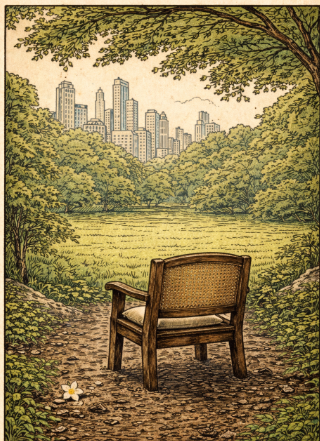
Notice the Card
Now take a moment to look at the card image.
What do you notice?
You might observe:
where the chair is placed
the surrounding environment
the condition of the chair
what kind of place it seems to belong to
the feeling of the space
Let your eyes move slowly around the image.
There is no need to interpret it. Simply notice what draws your attention.
You might ask yourself:
What feels familiar here?
What feels different from my own chair?
What kind of moment might happen in this place?
Now gently return your attention to the chair you are sitting in.
How is your relationship to your chair similar to the one in the image?
How is it different?
Step 3 — Change One Small Thing
Now gently shift one aspect of your relationship with the chair.
You might:
lean slightly forward
lean slightly back
move your feet
adjust how your hands rest
sit taller
soften your shoulders
Make only a small change.
Notice what happens when the relationship between your body and the chair shifts.
Does the chair feel different?
Do you feel different?
Step 4 — Explore Two Possibilities
Now experiment with two different ways of sitting.
One might feel more:
active
alert
engaged
The other might feel more:
supported
relaxed
grounded
Move slowly between these two ways of sitting a few times.
Let the chair support both possibilities.
As you do, notice whether this also shifts what you are sitting with mentally, emotionally, socially, or spiritually.
Does your stress feel different?
Does a relationship issue feel closer or farther away?
Does your sense of support change.
Reflection
Pause again.
Notice what shifted.
You might ask yourself:
What was I sitting with when I began?
How did my body show that?
What did I notice about the chair itself?
How did the chair’s material, quality, or placement affect my experience?
Did changing how I sat change what I was holding mentally or socially?
What kind of support was available that I had not fully noticed?
Sometimes insight comes not from solving a problem, but from changing how we relate to support, environment, and what is already with us.
A Note About the Cards
The Discovery Cards invite this kind of exploration.
A card can be reflected on, placed in your environment, and related to physically. It can become part of the space around you and part of the relationship you are in.
In that way, a card is not only something to interpret. It can become something that sits with you.
The Discovery Cards invite reflection through image, environment, and embodied attention.
Over the coming months we’ll share more preview practices and invitations to early workshops exploring the cards together.