
Field Note #4: What the Cards Make Possible
What the Cards Make Possible
A few months ago, I had a conversation with a local community organizer friend. I was asking them for support in reaching out to caregivers for a project that Moving Rasa was doing with the Department of Health and Mental Hygiene. I shared that we would use a few Discovery Cards to anchor the creation of a zine we would make with caregivers on how they could develop relational capacity for themselves in their caregiving.
He misunderstood me and did not realize that the cards themselves were mostly done and that we would use three of them to anchor the creation of a zine. He rhetorically asked me if I would be making money from the Discovery Cards. He said that if it is created with the community, it must be free.
I was shaken by the question/ statement.
For the three years before that conversation, Moving Rasa had moved to offering almost entirely free programming, thanks to a two-year capacity-building grant from the American Rescue Plan to work with Southeast Asian diaspora and Pacific Islander survivors. It supported us in becoming a viable nonprofit, mission-driven organization doing programming around the country. I was full-time, with part-time staff helping me run programming and administration.
While the grant was only for two years, we secured other contracts and donations that helped us continue for another year and “some change” (We are currently in the “some change” phase). So when I was asked this question, I had been doing three years of virtually free programming. It made sense. Many of the marginalized communities we worked with did not have the means to pay for care work.
Within the current funding climate and the needs of our nonprofit, I had committed to creating a product: the Discovery Cards.
They could support people in developing an independent practice while also creating a financial doorway for Moving Rasa to continue its mission.
While I knew he had misunderstood me, the question struck a chord and helped me notice something I had been conflating.
The Discovery Cards were a tool that had reached a stage of completion that allowed for testing. The zine I would create for this project was also a tool. The framework of Moving Rasa had also reached a stage of completion that is distinct in supporting people in building relational capacity.
I started recognizing this in work we were already doing.
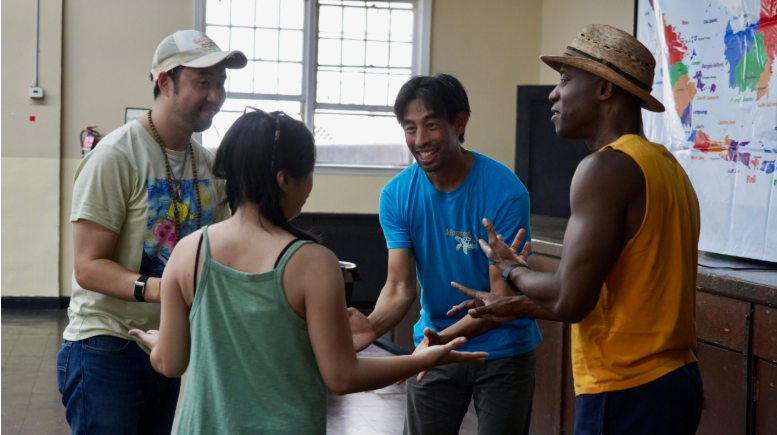
At Womankind, I invited participants to choose between two Discovery Cards as part of introducing themselves to the group. After they did an icebreaker to get comfortable with each other and the room, the card they chose became a companion to help them explore interactions with the place.
One participant danced in the ambiance of the office plants, smiling as if surrounded by a rainforest. Another commanded a stretch of floor to become their runway to enter like a fashion model. Each card was a companion, inviting ways to move in their body and the place that went beyond their prescribed behaviors of how they were supposed to behave,
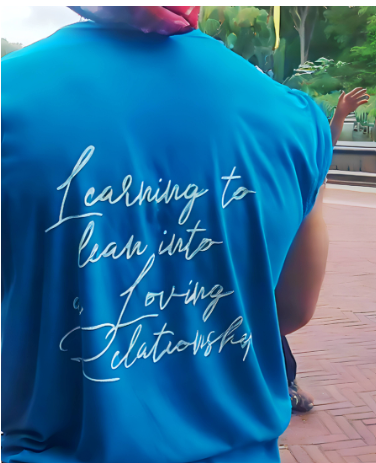
In Indonesian, there is a term, gotong royong—to shoulder a burden collectively. The card shared some of the burden of showing up. It was such a gift to see each survivor access deeper connections to themselves in their introduction through the support of the room, the cards, and one another.
Looking backward, I realize relational capacity has been a thread throughout much of my work.
The Discovery Cards give us a place to practice this because relationships are usually something we are simply inside of. We don't always stop to notice how we are doing it.
The cards are still a product I'm deeply invested in making. But I realized that the cards are not what I am selling. What I am selling is the possibility for people to experience and cultivate relational capacity with ourselves, other people, questions, and the living world.
Relational capacity doesn't mean knowing what's going to happen. It means developing trust in the capacity of our relationships to meet what happens.
There is a collective sigh of relief in that.
We don't have to know exactly where we're going to know that we can find our way together.
-Andrew
P.S. After Carol Swann in the Bay Area tried out some of the free offerings (you’ll find the button at the end of this Field Note), she reached out because she wanted to purchase two decks. The problem was, the website wasn’t ready for her!
While the Kickstarter will launch sometime this fall, her request made me realize that people don’t have to wait until then to reserve a deck.
I’m committed to supporting people in cultivating relational capacity through the Moving Rasa Discovery Cards. If you’re ready to commit to a deck now, you can reserve one. These early purchases will go directly toward paying the artist and helping us move the cards closer to production.